After pushing the car to get it started, we were off on our two day journey. We arrived in Korogwe around 11 a.m. and went to pick up the District Advisors for the area. Tanzania is divided into regions and each region is divided into districts. Each district has 4-H District Advisors who over the 4-H clubs throughout their district. We traveled down the all-too-familiar bumpy roads and stopped at a little house with 20 women sitting out front.
The first club we met with was an all-female club in which the women have only completed primary school. The club has 30 members all of whom have their own income-generating projects. Many of the women raise chickens as their individual project while others grow and sell vegetables from their gardens. Some of the women described how 4-H has helped them become successful business women because before they joined 4-H, they did not understand many of the medicines available for animals. These medicines help keep the animals healthy longer, so the women can now make a greater profit from their animals.
All of the women had at least one child, but because of 4-H, the women have a better understanding of time management. 4-H has taught them how to raise and take care of their children while still maintaining a successful business. These women were all very thankful for the support they have received and the skills they have learned through the 4-H program.


After meeting with the women, we headed to a busy bus stop for lunch. This bus stop is the half-way point between Dar es Salaam and Arusha (Kilimanjaro), a 12 hour journey. It is a very hoping joint with many venders selling everything from meat to fruits. I had a common meal that many Tanzanians enjoy-meat and chips. Beef is called meat and french fries are called chips. The meal comes in a foil container where you must use toothpicks to eat. The meat is fresh-as in, just butchered right before you eat it, so you have to pick around the bones and fat, but it's pretty darn good.
After lunch we headed out to some home visits, where we got to see women working their small businesses. The first women we met with was Amina, who owns her own salon. She invited us into her small saloon and spoke with us while she was braiding another woman's hair. She has been involved in 4-H for two years and has had her own business for one year. The management training that she has received through 4-H has helped her become successful to where she now makes a profit of 20,000-30,000 Tsh per day. 30,000 Tsh (Tanzanian Shillings) is equal to about $20 USD. The confidence she has gained from 4-H has allowed her open her own business, and because of her success, she tries to encourage others to become 4-H members. She serves as a model for other women interested in entrepreneurship in her village.
 Our next stop was to meet with Veronica, who has been a member of 4-H for two years. She makes her living by dying her own batiks and designing and producing dresses. 4-H has taught her how to market her clothes to the women in her village. Furthermore, she has learned how to take care of the customer. Before her involvement in 4-H, Veronica was making 50,000 Tsh per month. She now makes more than 70,000 Tsh and can make more than ten dresses in a week. She owns two sewing machines, which are operated manually with a foot pedal, and is working on saving up enough money to buy an embroidery machine, which will allow her to greatly expand her business. In addition to producing clothes, this successful women teaches three younger girls about the art of sewing. She charges the young girls a small fee in exchange for the valuable entrepreneurial skills that Veronica possesses.
 Our third stop was to the home of Asnath, who has been a member of 4-H for three years. She makes her living from the restaurant that she owns, which is a hut in front of her house. She has seen a positive change in her life from her involvement in 4-H. Before 4-H, Asnath worked at a restaurant where she struggling to get by. Because of the knowledge she has gained through 4-H, Asnath owns her own restaurant and even employes another women. She now makes 3,000 Tsh each day in addition to taking care of two children.
 We drove quite a ways to meet up with Janet who has been in 4-H for three years. Janet has become incredibly successful with the skills she has learned through 4-H. She was selected as one of twelve women to attend a vocational training session taught by 4-H Tanzania. The training session taught her about tailoring, making batiks, and making jewelry. Her self-confidence and decision making skills as well as her ability to work with others has helped her make over 400,000 Tsh by selling her clothing and jewelry to shops around the village. Janet showed us some of her work, which was incredible, so Chloe and I bought a couple bracelets as well as a batik that she hand-painted.
Our last home visit was with Matilda who has been a member for three years. She had a stand out her home where she sold vegetables and fruits from her garden. She also makes and sells batiks and clothing. She has been able to open up her own bank account where she can start saving the money she makes from her business. Her confidence and entrepreneurship skills have helped her earn more than 20,000 Tsh per month.

As we were visiting with Matilda, a swarm of children started watching us. I had a hard time concentrating on our interview because the children were so curious with me and Chloe. After our interview we spent some time playing with and taking pictures of the children. They cheered and cheered every time the flash on my camera when off and they laughed hysterically when they saw themselves in the pictures. The children are the best part about this country.


 After our home visits we headed back to our hotel to clean up. I had the opportunity to take a hot shower, so I may have stayed in the shower a few extra minutes. The reason there was hot water at this hotel was not because they have a water heater. Ooh no, instead they have an electric heater in the shower head. If you ask me, it's a really easy way to get yourself electrocuted. But my reasoning is, if Africans can manage to do it, so can I. I did accidentally touch the shower head, and yes, it does shock you. I may just stick to cold showers if my only other option is to use an electric shower head that plugs into the wall of the shower.
After freshening up, Josef, Manase, Gudila, Chloe, and I went out for dinner. The evening was the longest, yet most enjoyable evening I have had. We ordered our dinner around 6:30 p.m. If you haven't figured it out by now, time doesn't mean anything in Tanzania. At 7:30, after some great laughs, I asked when our food would be ready. Manase went to ask the chef how much longer it would be and he told me it would be about another 30 minutes. As if my stomach wasn't growling enough, I waited a little longer. After some more great laughs and jokes that I should probably not share with the public, I asked if the food was ready. That's when I learned the term "bado kidogo," which means "in a little bit." It was a little bit longer...9 p.m. when we received our meal. But, it was well worth the wait. It was great food and great company-a good way to end a great day.
The next morning we headed out into the Usambara Mountains to meet up with our first club of the day. We met with a primary school at the foot of the mountains. As we drove up, the children's faces lit up and they began singing their 4-H pledge for us. They created a pathway and continued singing to us as we walked passed them. We sat down and they began to sing another song. Just as I sat down, a little girl came up to me and held out her hand as if she wanted to dance with me. Not knowing what I was doing, I got up and followed her to the open area in front of us. The beat of the music changed and she suddenly began swiveling and shaking her hips. Still not knowing what was going on I started shaking my hips too as all the children began to chuckle. The children went down the row so Chloe, Gudila, Manase, and Josef each got their turn to shake it. Just when I thought we were done, I was told it was my turn to go pick a student to dance with, so I slowly made my way over to the children dancing to the beat of the music. I extended my hand to a shy girl and then I started shakin' my hips. As if we hadn't already received the most uplifting welcome, the children began to singing "We are so ha-ha-ha-happy to say welcome." It was the most heartwarming experience I have had yet.


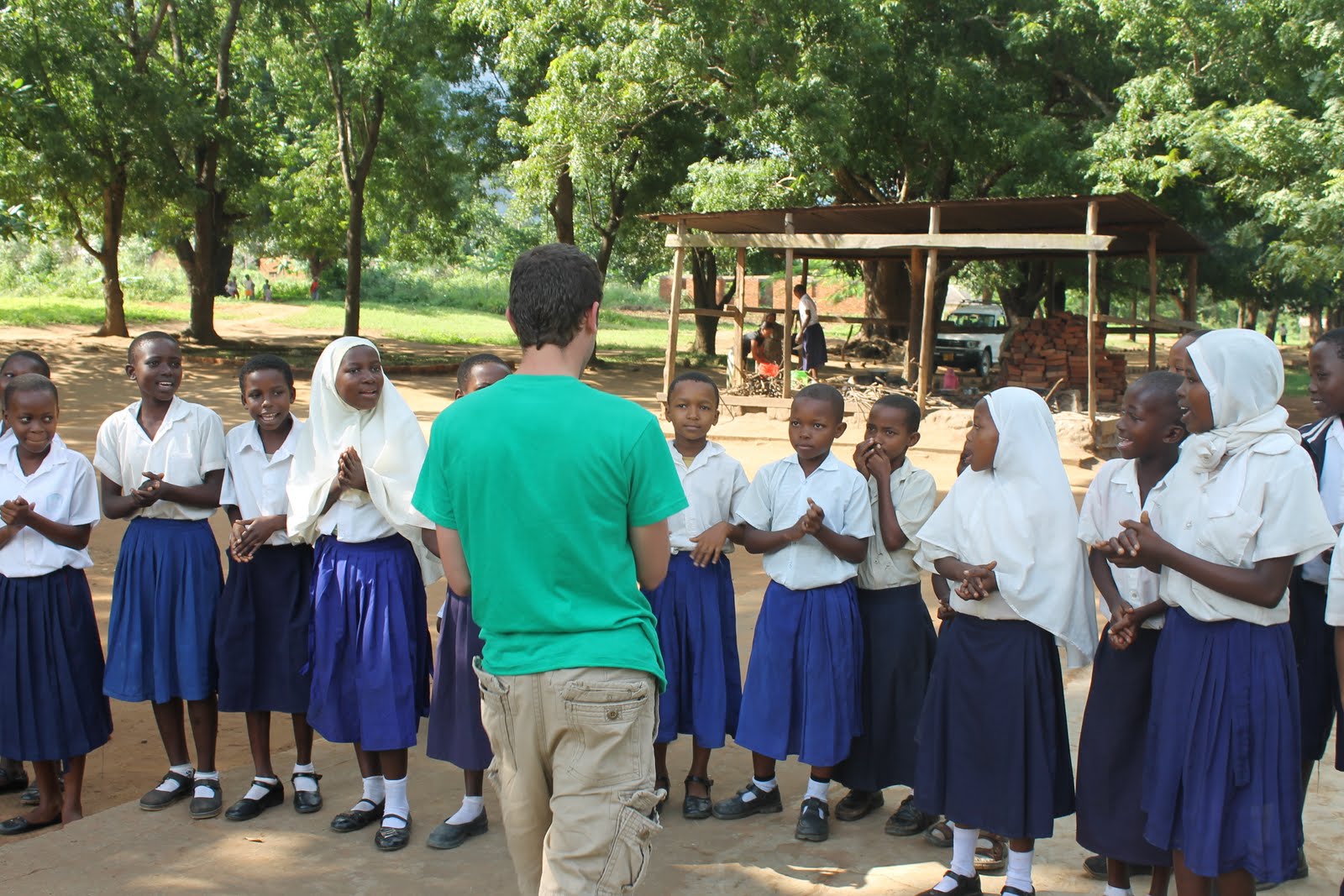


 After singing and dancing with the children, we went to speak with the club advisors to get a better understanding of their perceptions of their students. The Kwagunda Primary School has been around for ten years and has 126 4-H members ranging in age from 9-14. They have two club projects that they work on together, which consists of tree planting and growing corn on their two acres of land. The money that the club earns from their club projects help pay for medical expenses if any of the children become ill. The club has a meeting every three months, but they meet in-between to work on their own individual club projects. Most of the children's individual projects consist of either poultry keeping, goat keeping, or tree planting. The advisors did say that water is something they desperately need. They have a hard time taking care of their trees and corn fields because they have very little irrigation. They have a well pump, but they just need a little extra money so they can dig the well.
  We spoke with about 30 children after meeting with the club advisors. The children spoke of how much they enjoyed 4-H because it has taught them entrepreneurship skills that will help them sustain themselves in the future. They all want to grow up to become farmers, so the husbandry skills, tree planting knowledge, environment protection lessons, and garden keeping skills, will all help these children become successful farmers in the future. We asked them what kind of things they would like to learn from 4-H members in the United States that they were most interested in the type of projects in U.S. clubs. They were also very interested in technology and wanted to learn about the different cars and computers that we have in the United States.
The children took us out to see their corn fields behind the school. They were so proud to show us their projects and thrilled that we were taking pictures of them with their corn. As we headed back to the car, the children huddled around us and walked as close as they could to me and Chloe. They started touching our hair and skin and they were so fascinated with the differences. I handed out some of the 4-H gifts that I brought from home, which they were very excited to see. We showed them how to use the frisbees and then it was time to go. As we drove away, the children lined the driveway and sang to us as we left.


The second and last school that we visited was Hale Primary School, which had a total of 289 members divided amongst six club advisers. The club advisors, again spoke of how they have little access to water, which makes it hard for the children to work in the 1/4 acre corn and vegetable garden. The club is currently looking for more space so they can begin a poultry keeping project. The club meets two times a year as a club, but they meet regularly to work on individual club projects.
The schools in Tanzania are on holiday so most of the children where not around. We spoke with about 30 members from the Hale Primary School club. They said they liked 4-H because of the environment protection skills, leadership skills, the independence they have gained, planning for their futures, and the money they have earned from their projects, which has allowed them to afford an education. This club was most interested in learning about the American culture. They wanted to know the types of foods we eat, how we live, what types of sports and activities we have, as well as what Americans learn in 4-H. Similarly, the children want to teach Americans about their own cultures. They want to teach U.S. clubs about their foods, nature, agriculture, fishing, the language, sports, fashions, and how they use a hand hoe for digging. One young student quietly raised her hand and with confidence, she said she wanted to teach U.S. clubs how they lead others. I think there is a lot to be learned from these incredibly driven, hard-working, and extremely proud children.